



What Is a Solar Array? A Guide for Commercial Installers
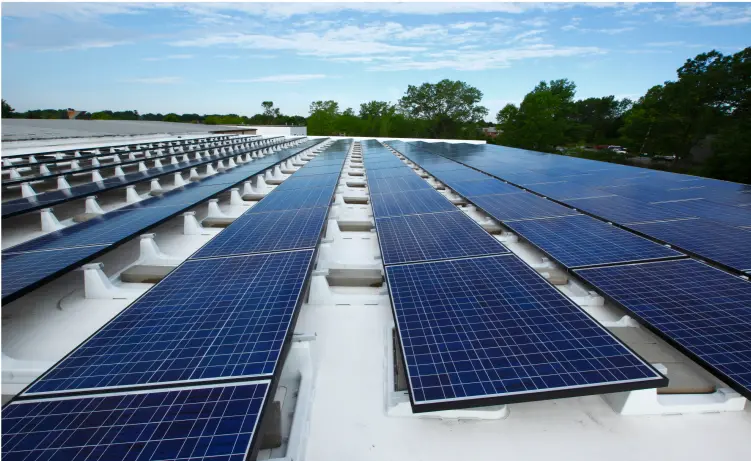
For commercial installers and project engineers, the solar array is where system performance begins. Every panel, rail, bond, and wire path affects output, safety, and installation time. Understanding how a solar array works and how racking, grounding, and wire management support it helps crews build systems that install faster, pass inspection, and perform reliably for years.
What Is a Solar Array?
A solar array is a group of connected solar panels that work together to produce electricity. Instead of one panel operating alone, multiple panels are wired and mounted as a single system to generate usable power at a larger scale.
Here is the basic structure:
- A solar module (panel) produces DC power.
- A string is several panels wired together to increase voltage.
- A solar array combines multiple strings into one coordinated power system.
Commercial arrays are larger and more structured than residential systems. They often cover large flat roofs and must account for wind, roof load limits, grounding continuity, and organized wiring across long rows of panels.
Array design directly affects:
- Total energy output
- Structural performance and wind resistance
- Roof load distribution
- Installation speed and repeatability
In commercial projects, the array is not just panels; it is a complete structural and electrical framework.
Key Components of a Commercial Solar Array
A commercial solar array includes several core parts that must work together for safe and reliable operation.
- Solar modules (panels): Modules generate DC electricity. Their size and layout determine how strings are configured and how much power the system produces.
- Racking and mounting systems: Racking supports the modules and transfers loads to the roof. Systems like the DynoRaxx Evolution FR Flat Roof System are designed for consistent spacing, predictable layout, and stable performance on commercial flat roofs.
- Grounding and bonding: Grounding ensures electrical continuity across the array and supports code compliance. Integrated solutions such as DynoBond Grounding reduce the need for separate bonding hardware while maintaining a continuous ground path.
- Wire management: Clean wire routing protects conductors and improves long-term reliability. The DynoRaxx Wire Pocket helps secure wiring, prevent sagging, and keep installations organized across large arrays.
- Inverters and balance of system: Inverters convert DC power into usable AC electricity. Other balance-of-system components include combiner boxes, disconnects, and electrical protection devices that must align with array layout and wiring design.
When these parts are engineered to work together, installers get faster builds, fewer adjustments, and more consistent system performance.
How Solar Arrays Are Designed for Flat Roof Projects
Flat roof arrays require careful planning to balance performance, structural safety, and installation efficiency.
- Tilt and row spacing: Tilt angle affects energy production and wind exposure. Proper row spacing prevents shading while maximizing usable roof space.
- Wind uplift and ballast: Commercial arrays must withstand wind forces without overstressing the roof. Engineered ballast and aerodynamic racking designs help maintain system stability.
- Roof load distribution: Weight must be spread correctly to avoid damaging the roof. Racking layout plays a major role in managing load points across the structure.
- Drainage and roof access: Array layout must allow water to flow properly and maintain service pathways for inspection and maintenance.
A well-engineered racking system simplifies these decisions by providing consistent geometry and reducing layout adjustments in the field.
Improving Installation Efficiency Through Smarter Array Design
Installation speed and consistency often depend on how the array is engineered before crews arrive on site.
- Pre-engineered layout: Racking designed for repeatable placement reduces measuring, alignment work, and layout errors.
- No-tool installation: Tool-free components speed up assembly, reduce fatigue, and improve installation consistency across large systems.
- Integrated grounding: Built-in bonding removes extra steps, reduces loose hardware, and helps systems stay inspection-ready.
- Standardized components: Using consistent parts simplifies training, reduces rework, and improves quality across multiple projects.
DynoRaxx systems are designed to support installer workflow, helping crews build commercial arrays faster while maintaining structural and electrical reliability.
Build Better Solar Arrays with DynoRaxx
A solar array is more than a group of panels. It is a fully engineered system that must balance structure, electrical safety, and installation efficiency. Racking, grounding, and wire management all play a direct role in system performance and long-term durability.
With DynoRaxx racking, grounding, and wire management solutions, commercial installers can build solar arrays that install faster, meet compliance requirements, and perform reliably over time.
Explore commercial solar racking and array solutions by contacting our team.